Ferber vs CIO vs PUPD vs Gentle Sleep Training: Which Method Is Right For Your Baby?
This post contains affiliate links. If you purchase through these links, I may earn a small commission at no extra cost to you.
Your baby has woken up for the fourth time. You are sitting in the dark, running on nothing, and a small, desperate part of your brain is Googling “sleep training methods” while the rest of your brain is feeling guilty for even having the thought.
If that is where you are right now, you are not a bad mom. You are in the trenches. And you deserve a real answer, not another page that makes you feel judged before the second paragraph.
This post is that answer. Every major sleep training method, explained clearly, without an agenda. No picking sides. No “breast is best” energy about any of this. Just the honest, factual breakdown you have been looking for so you can make the right call for YOUR baby and YOUR family.
What Sleep Training Actually Is (And What It Is Not)
Before we get into methods, let’s clear something up, because the internet has done a lot of damage on this front.
Sleep training means teaching your baby to fall asleep independently. That is it. It does not mean abandoning your baby, ignoring all crying forever, or following one rigid approach regardless of how your baby responds. It does not mean you love your baby less. It does not mean you are choosing your sleep over your child. Every major pediatric organisation, including the American Academy of Pediatrics, supports sleep training when done at the appropriate age. The research consistently shows it does not cause emotional harm. You can read more about the full evidence picture in the complete baby sleep guide if you want to go deeper before committing.
The two questions parents always ask first: “Will this hurt my baby?” and “Is my baby too young?” The honest answer is no and maybe. Most methods are appropriate from 4 to 6 months, once the 4-month sleep regression has settled. Under 4 months, your baby does not yet have the developmental ability to self-settle reliably, so holding off is not weakness, it is timing.
Now, let’s talk about your options.
The Sleep Training Methods: An Honest Comparison
Every method below works. The difference between them is not effectiveness, it is fit. How much crying can you handle? How old is your baby? How consistent can you and your partner realistically be? Those answers point you toward your method.
The Ferber Method (Graduated Extinction / Check and Console)
This is the most-searched sleep training method on Pinterest for good reason. It is structured, measurable, and gives you something to do instead of just waiting.
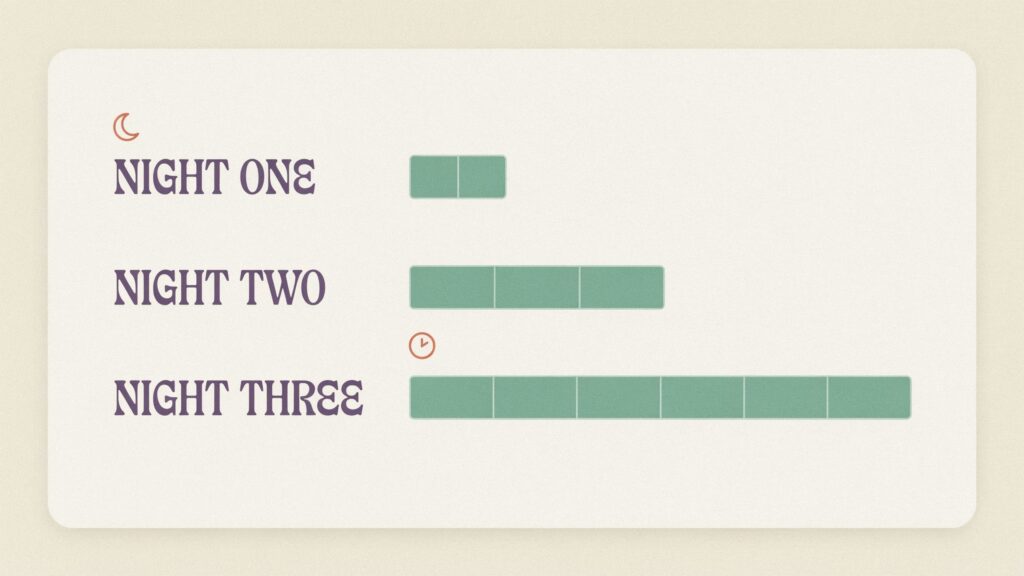
Here is how it works: you put your baby down drowsy but awake, leave the room, and return to briefly check on them at timed intervals. The intervals increase as the nights go on. You are not ignoring your baby completely, you are just stretching the time between responses. The checks are short, around a minute, and you do not pick the baby up to fully calm them, just offer a quick reassuring touch and leave.
The Ferber waiting times chart (the most-saved sleep training pin since 2017, and now you know why) looks like this:
| Night | Interval 1 | Interval 2 | Interval 3 |
|---|---|---|---|
| Night 1 | 3 minutes | 5 minutes | 10 minutes |
| Night 2 | 5 minutes | 10 minutes | 12 minutes |
| Night 3 | 10 minutes | 12 minutes | 15 minutes |
| Night 4 onwards | Extend intervals | Extend intervals | Extend intervals |
Most babies trained with Ferber are sleeping through within 3 to 7 nights. The structure is genuinely helpful for parents who need to feel like they are doing something rather than just waiting out the storm.
Best for: Parents who cannot handle sustained crying but need a clear plan to follow. Works well from 4 to 6 months onwards. Good for babies who respond to brief parental reassurance.
The honest downside: some babies actually escalate when you go back in. If your baby gets more upset every time you check, consider CIO or the chair method instead.
If you want the detailed breakdown of the Ferber method from the source, Solve Your Child’s Sleep Problems by Richard Ferber is the original book and still worth reading.
Cry It Out / Full Extinction (CIO)
CIO gets the worst reputation and the strongest results, and that is not a coincidence.
With full extinction, you put your baby down awake, leave, and do not return until morning or the next scheduled feed. No check-ins. No intervals. No going back in unless you have a true concern (fever, illness, genuinely unusual distress).
It sounds brutal. For many parents it is genuinely the hardest thing they have done. But the research shows it resolves fastest, often within 3 to 5 nights, and the evidence of long-term harm to babies is not there. Full stop.
Best for: Parents who have already tried Ferber or gentler methods and had partial success, or parents who know from their own temperament that the check-ins would make their anxiety worse rather than better. Also works well for babies whose crying escalates every time a parent re-enters.
The honest downside: night 1 and night 2 are genuinely hard. Have a plan for where you are going to be so you are not sitting outside the door. Some parents find it helps to do this when a partner is home. Others prefer to do it alone because having someone else in the house creates more pressure.
Pick Up Put Down (PUPD)
PUPD is exactly what it sounds like. Your baby cries, you go in, pick them up until they are calm, put them down drowsy, and repeat until they fall asleep on their own.
The idea is that you are never leaving them to cry alone for more than a few seconds, but you are also consistently reinforcing the message that the crib is where sleep happens.
Best for: Younger babies around 4 to 5 months and parents who need hands-on involvement to feel okay. If you are not yet comfortable with any form of cry-based method, this can be a bridge.
The honest downside: it is exhausting and slow. Some nights it takes 30 to 60 repetitions before your baby settles. Some babies find the repeated pick-up-put-down more stimulating than soothing, which can backfire. If you are three nights in and it is getting worse not better, that is a signal to pivot.
The Chair Method / Sleep Lady Shuffle / Fading
With the chair method, you start by sitting in a chair next to your baby’s crib on night 1. You are there, you can offer brief verbal reassurance, but you are not picking up or feeding to sleep. Every two to three nights you move the chair a little further from the crib, until eventually you are outside the room entirely.
The fading approach is similar in spirit: you gradually reduce your involvement over a period of weeks rather than days.
Best for: Parents who need to be physically present in the room to tolerate the process. Also works well for babies with stronger separation anxiety or babies who have been contact-napping for months and need a slower transition away from parental proximity.
The honest downside: it is the slowest method. “Slow and steady” sounds reassuring until you are on week 3. You need genuine patience and consistency for this one. If your partner is doing different things on alternating nights, it will not work.
Gentle Sleep Training / No-Cry Approaches
Gentle methods cover a wide range of approaches, all of which involve a gradual reduction of the sleep associations your baby has built up, usually feed-to-sleep association or contact napping, over a period of weeks.
This might look like gradually reducing the amount you feed before putting baby down, or slowly shortening the time you spend rocking before the transfer, until eventually the baby is falling asleep with minimal input.
Best for: Parents who cannot tolerate any sustained crying, parents of younger babies under 5 months, and families where the current situation is manageable enough to take a slower road.
The honest downside: it takes longer, sometimes significantly longer, than cry-based methods. It also requires very precise consistency across every nap and every overnight wake, which is genuinely hard to maintain when you are already running on empty. Many parents start gentle methods and slowly drift back into old habits, which means weeks of effort with no result. That is not a character failure, it is just worth knowing going in.
For a thorough and compassionate guide to the gentle approaches, The Happy Sleeper by Heather Turgeon and Julie Wright is the book most frequently recommended in the gentle sleep community.
The 333 Method
You may have seen this one on social media. It is newer and does not have the same research base as Ferber or CIO, but it is gaining traction for parents who want a structured middle ground.
The basic idea: 3 minutes of crying before first check-in, 3 minutes of soothing, 3 minutes of waiting. Repeat. The appeal is the simplicity and the clear structure for parents who find Ferber’s escalating intervals overwhelming.
It is not yet supported by the same volume of research as the established methods, but anecdotally many parents find it helpful, particularly as an entry point if they are anxious about sleep training for the first time.
The Full Comparison at a Glance
Here is how the methods stack up. Use this as a reference, not a verdict.
| Method | Crying Involved | Time to Work | Best Age | Best For | Hardest Part |
|---|---|---|---|---|---|
| Ferber | Moderate (intervals) | 3-7 nights | 4 months+ | Parents who need structure and can’t handle sustained crying | Second-guessing the check-ins |
| CIO | High (no checks) | 3-5 nights | 4-6 months+ | Parents who tried partial methods; self-described “rip the bandaid” types | Night 1 and 2 |
| PUPD | Low-moderate | 1-3 weeks | 4-5 months | Parents who need hands-on involvement | Physical exhaustion; some babies escalate |
| Chair Method | Low | 2-4 weeks | Any age | High-anxiety parents; strong separation anxiety in baby | Consistency across all carers |
| Gentle/No-Cry | Very low | 4-8 weeks+ | Any age (best under 5 months) | Anti-cry households; manageable current situation | Maintaining precision and consistency long-term |
| 333 Method | Moderate | Varies | 4 months+ | Structure-seekers; newer to sleep training | Limited research base |
How to Choose YOUR Method
Nobody can tell you which method is right for your baby. But three questions will get you most of the way there.
First: how much crying can you actually tolerate on night 1? Not in theory, but in reality. If the answer is “not much at all,” you are in gentle or chair method territory. If the answer is “I am so desperate I can handle a hard few nights if it actually ends,” you are probably looking at Ferber or CIO. Be honest. The method you can actually follow consistently will always outperform the method you abandon after 45 minutes.
Second: how old is your baby? Under 4 months, most sleep training methods are not developmentally appropriate and the 4-month sleep regression may still be disrupting any pattern you try to establish. Between 4 and 6 months, most methods are fair game, with Ferber and PUPD being natural starting points. Over 6 months, all methods are appropriate, though gentler approaches take significantly longer the older and more established the sleep habits become.
Third: what is your actual problem? A baby with a feed-to-sleep association needs something different from a baby who has been contact napping for seven months. A baby who wakes every 45 minutes is hitting the end of a sleep cycle — wake windows are probably the piece to fix first. A baby who wakes at 2am and will not go back without being fed is a different puzzle.
The right method is the one you can commit to consistently for at least five nights. Picking a method and starting is better than three more weeks of researching the perfect approach.
If you want one book that bridges all of these and helps you think through the decision calmly, [AFFILIATE-LINK-NEEDED: Precious Little Sleep by Alexis Dubner] is the one most commonly described as “the book that finally made it click.”
Sleep Training by Age: Quick Reference
Not all methods suit all ages. Here is a quick guide.
0 to 3 months: No formal sleep training recommended. Focus on building a loose feed-wake-sleep routine. Newborns cannot self-settle developmentally. The goal is learning their cues, not solving night waking. If you are in this stage and exhausted, you are not behind, you are just in the hardest stretch.
4 to 5 months: The 4-month sleep regression may be wrapping up. Most babies are now developmentally ready for some form of sleep training. Ferber and PUPD are good starting points. Gentle approaches also work well at this stage and take less time because the associations are less entrenched.
6 to 8 months: Prime window for most methods. Babies have the developmental capacity to self-settle. Ferber and CIO both work efficiently here. If you have been contact napping or feeding to sleep until this point, it is still very fixable, just be prepared for a few harder nights.
8 to 12 months: Separation anxiety may start complicating things around 9 months, which can make Ferber feel harder. The chair method works particularly well here because your physical presence addresses the anxiety without reinforcing the old sleep associations.
12 months and up: Sleep training still works at any age, but it usually takes longer the older the habits are. Consistency becomes even more important. Make sure the wake windows are right for your toddler’s age before you assume it is a sleep training problem.
If you are unsure whether your baby’s wake windows are on track before you start, that is a great first thing to check. A wake window that is too short means your baby is not tired enough to sleep. One that is too long means they hit overtiredness, which makes falling asleep harder, not easier. Our wake windows by age guide walks through every age from newborn to 18 months in detail.
The 5 Most Common Sleep Training Myths
Myth 1: Sleep training means leaving your baby to cry indefinitely.
It does not. Ferber, PUPD, the chair method, and gentle approaches all involve parental presence and response. Even CIO involves checking that your baby is safe. The myth that sleep training equals abandonment is the biggest reason parents delay for months and suffer in the meantime.
Myth 2: Sleep training causes attachment damage.
Multiple large studies have followed children who were sleep trained into childhood and found no difference in attachment, emotional development, or mental health compared to children who were not. The attachment relationship you build with your baby during waking hours is what matters, not whether you use a sleep training method at night.
Myth 3: You have to let them cry for hours.
Most babies trained with Ferber or CIO hit peak crying on night 1 and night 2 and then reduce significantly. By night 3 to 5, most crying has dropped dramatically. The “hours of screaming” scenario is usually the exception, not the rule.
Myth 4: Sleep training only works for some babies.
It works for most babies at the appropriate developmental stage. The method may need adjusting, and the timing may matter, but the principle of teaching independent sleep is something almost all babies are capable of, not a genetic lottery.
Myth 5: If you tried it once and it did not work, you cannot try again.
You absolutely can. Many parents do Ferber once, fall back into old habits during an illness or a trip, and have to re-train. A second or third sleep training effort is normal and is usually faster than the first.
How to Prepare for Night 1
The parents who struggle most with sleep training are the ones who go in under-prepared. Night 1 is always the hardest. Setting yourself up properly makes a real difference.
Step 1: Align with your partner first. If one of you is going to go in against the plan at 1am, the training will not work and you will both feel worse. Decide together which method you are using, what your check-in plan is, and what you will do if one of you starts to crack. Write it down if it helps.
Step 2: Set a consistent bedtime routine and keep it under 30 minutes. Bath, feed (do not feed to sleep), dim light, white noise on, down in crib. The routine signals to your baby that sleep is coming.
Step 3: Sort the room. Blackout curtains or blinds. White noise machine running at around 65 to 70 decibels, about the sound of a running shower. Room temperature between 68 and 72 degrees Fahrenheit. Sleep sack instead of loose blankets : white noise machine for baby
Step 4: Do not start on a travel week, around vaccinations, or when your baby is sick. Set yourself up for a normal week.
Step 5: Decide in advance what you are going to do with yourself. Sitting outside the door is the hardest possible thing. Plan to watch something, sit in another room, take a walk if a partner is home. Give your brain something else to do.
Step 6: Commit to at least five nights. Three nights is not enough to judge. Most parents who give up at day 2 or 3 give up right before things would have turned the corner.

You Did Not Wait Too Long
There is a story that runs through the sleep training forums and the 2am Reddit threads, and it sounds a little like this: I waited fourteen months suffering every night because I thought I was supposed to just survive it. I wish I had done this so much sooner.
That story is not rare. It is the most common one.
You are not a bad mom for wanting to sleep through the night. You are not choosing yourself over your baby. You are trying to be a functional human so that you can actually show up for them during the day. Those are not competing priorities. They are the same priority.
Pick the method that fits your family. Commit to five nights. Let yourself do this.
If you want the full evidence-based picture on baby sleep before you start, the complete baby sleep guide covers everything from newborn sleep cycles to sleep regression timelines in one place.
You have got this.