It’s 3 a.m. You’ve fed her, burped her, changed her. She finally fell asleep in your arms — and the moment you lowered her into the crib, her eyes flew open.
If you’re reading this on your phone in a dark room right now, this guide is for you.
Baby sleep is one of the most talked-about topics in parenting — and one of the most confusing. Everyone has an opinion. The internet gives you fifteen conflicting answers. And your baby hasn’t read any of the books.
This guide cuts through all of that. It covers everything you actually need to know about baby sleep from birth to 12 months — wake windows, safe sleep, schedules by age, common problems, and how to gently build better sleep habits without losing your mind.
Bookmark this. You’ll come back to it.
FTC Disclosure: This post contains affiliate links. If you purchase through these links, we may earn a small commission at no extra cost to you.

Why Baby Sleep Is So Different From Adult Sleep
Understanding why babies sleep the way they do makes everything less maddening.
Adults cycle through deep sleep and light sleep roughly every 90 minutes, spending most of the night in restorative deep sleep. Babies have much shorter sleep cycles — typically 45 to 50 minutes — and they spend proportionally more time in active, light sleep than we do.
This is actually by design. Light sleep allows babies to rouse easily if something is wrong — temperature, hunger, breathing. It’s a survival mechanism, not a flaw.
The good news: as babies grow, their sleep cycles lengthen and they gradually develop the ability to connect sleep cycles on their own — which is the foundation of sleeping through the night.
That ability develops on its own timeline. It cannot be rushed, but it can be supported.
Wake Windows: The Single Most Useful Concept in Baby Sleep
A wake window is the amount of time your baby can comfortably stay awake between sleeps before becoming overtired.
Stay within the wake window and your baby will fall asleep more easily. Push past it and you’ve crossed into overtired territory — where cortisol spikes, your baby becomes harder to settle, and sleep quality drops.
Wake windows change significantly as your baby grows. Here’s a simple guide:
Wake Windows by Age
- Newborn (0-4 weeks): 45-60 minutes
- 1-2 months: 60-90 minutes
- 2-3 months: 75-90 minutes
- 3-4 months: 90 minutes-2 hours
- 4-5 months: 1.5-2.5 hours
- 5-6 months: 2-3 hours
- 6-8 months: 2.5-3.5 hours
- 8-10 months: 3-4 hours
- 10-12 months: 3.5-4.5 hours
Signs your baby is hitting the end of their wake window include: rubbing eyes, pulling at ears, yawning, staring blankly, or becoming fussier than usual. These are your cues to start the wind-down, not to wait and see. Use our free Wake Window Calculator to get your baby’s exact recommended wake window by age. →
Safe Sleep Guidelines 2026
Before we talk schedules and strategies, safe sleep comes first. Every time, no exceptions.
The American Academy of Pediatrics recommends the following for every sleep:
The ABCs of Safe Sleep
- Alone — baby sleeps by themselves, not with adults, siblings, or pets
- Back — always place baby on their back to sleep, every time, until age one
- Crib — use a firm, flat sleep surface with a fitted sheet and nothing else
What Should Not Be in the Sleep Space
- Pillows, blankets, bumper pads, or positioners
- Stuffed animals or soft toys
- Loose clothing or swaddles that have come undone
- Any sleep surface that isn’t firm and flat (couch, armchair, bouncer)
Room Sharing vs Bed Sharing
Room sharing — where baby sleeps in their own safe sleep space in your room — is recommended by the AAP for at least the first 6 months and ideally the first year. This is different from bed sharing, which carries significant safety risks and is not recommended.
Room sharing without bed sharing has been shown to reduce the risk of SIDS while still allowing parents to respond quickly to baby’s needs during the night.
Baby Sleep by Age: What to Expect
Newborn Stage (0-3 Months)
The newborn stage is the hardest — and the most misunderstood. Newborns are not developmentally ready to sleep through the night, and expecting them to do so will only lead to frustration.
What’s normal for a newborn:
- Sleeping 14-17 hours in a 24-hour period, broken into many short stretches
- Waking every 2-3 hours to feed — this is biologically necessary
- Day/night confusion for the first few weeks
- Short naps of 20-45 minutes, often contact naps
What helps at this stage:
- Swaddling — mimics the snug feeling of the womb and reduces the startle reflex
- White noise — recreates the constant sound environment of the womb
- Darkness for night feeds — keep lights dim to signal that night is for sleeping
- Feeding on demand — don’t try to stretch feeds at this age
3-6 Months
This stage brings the 4-month sleep regression — one of the most disruptive events in early parenting. Around 3.5-4 months, your baby’s sleep architecture permanently matures to become more adult-like. Sleep that was easy before can suddenly become difficult.
This isn’t a problem to solve — it’s a developmental milestone. It passes, though it can take several weeks.
What changes at this stage:
- More predictable wake windows (1.5-2.5 hours depending on age)
- 3-4 naps per day consolidating toward 3 naps
- Longer stretches at night becoming possible — many babies can now go 4-6 hours
- Circadian rhythm developing — consistent bedtime starts to matter
This is a good time to introduce a simple, consistent bedtime routine. 15 to 20 minutes is plenty. Bath, feed, song, sleep. The consistency is what signals to your baby’s brain that sleep is coming.
6-9 Months
By six months, most babies are developmentally ready to sleep longer stretches at night. Many can sleep 10-12 hours with one or two wake-ups.
Key changes at this stage:
- Naps consolidate from 3 to 2 (usually around 6-8 months)
- Wake windows lengthen to 2.5-3.5 hours
- Separation anxiety begins — can affect both naps and night waking
- Solid food introduction — timing of solids relative to feeds can affect sleep
9-12 Months
The 8-10 month period often brings another sleep regression as your baby hits major developmental milestones — pulling to stand, cruising, sometimes first steps.
What’s typical:
- 2 naps per day, moving toward 1 nap around 12-15 months
- Wake windows of 3.5-4.5 hours
- Night waking often tied to developmental leaps or separation anxiety
- Most babies this age can sleep through the night with appropriate support
Sleep Training: An Honest Overview
Sleep training is one of the most debated topics in parenting. This guide won’t tell you what to do — that’s your decision based on your family, your values, and your baby. What it will do is give you an honest overview of the main approaches.
Sleep training generally refers to methods that help babies learn to fall asleep independently — meaning they can put themselves to sleep at bedtime and return to sleep between sleep cycles without needing you to intervene every time.
The Main Approaches
- Extinction (“cry it out”) — You put baby down awake and don’t return until morning or a set time. Research shows it is not harmful to babies when used appropriately after 4-6 months.
- Graduated extinction (“Ferber method”) — You put baby down awake and check in at gradually increasing intervals. Provides reassurance while still allowing baby to learn to self-soothe.
- Fading methods — You gradually reduce your involvement over days or weeks. Slower but gentler. Includes chair method and pick-up-put-down.
- No-cry approaches — Focus on building positive sleep associations gradually without any crying. Often slower but preferred by parents who find extended crying distressing.
Important: Most sleep training approaches are not recommended before 4-6 months. Before that age, babies need night feeds and are not developmentally ready to self-soothe consistently.
Common Baby Sleep Problems (and What Actually Helps)
Baby Will Only Sleep on Me
Contact napping is completely normal, especially in the early months. Your body warmth, heartbeat, and smell are deeply calming for your baby. If it’s working for you, there’s no rush to change it.
When you’re ready to transition away from contact naps, do it gradually. Start with one nap per day in the crib, at the time your baby is most likely to sleep well. Warm the crib sheet with a hot water bottle before placing baby (remove it first), and try transferring when baby is in a deeper sleep phase — usually 15-20 minutes after falling asleep.
Short Naps (the 45-Minute Intruder)
Short naps are often a sign that your baby is completing one sleep cycle but not connecting to the next. This is developmentally normal before 4 months. After 4 months, it’s often worth troubleshooting.
Common culprits: overtiredness (check wake windows), under-tiredness (too short a wake window), environmental factors (too much light or noise), or needing help transitioning between cycles.
Early Morning Waking
Waking before 6 a.m. consistently is one of the more frustrating sleep challenges. Common causes include: too much daytime sleep, a bedtime that’s too late (counterintuitively, earlier bedtimes often lead to later wake times), light in the room, or a natural early chronotype.
Blackout curtains are the single most effective and immediate fix for many families. Try them before changing anything else.
Night Waking
Some night waking is completely normal through the first year and beyond. If waking is frequent after 6 months and not hunger-related, it’s often about sleep associations — your baby has learned to fall asleep in your arms, at the breast, or with a pacifier, and needs that same condition to return to sleep between cycles.
The gentlest way to address this is to gradually shift where your baby falls asleep — moving from nursing to sleep, to nursing then putting down drowsy, to putting down more awake over time.
The Ideal Baby Sleep Environment
Getting the sleep environment right is one of the highest-leverage things you can do. It works passively, every single nap and every night.
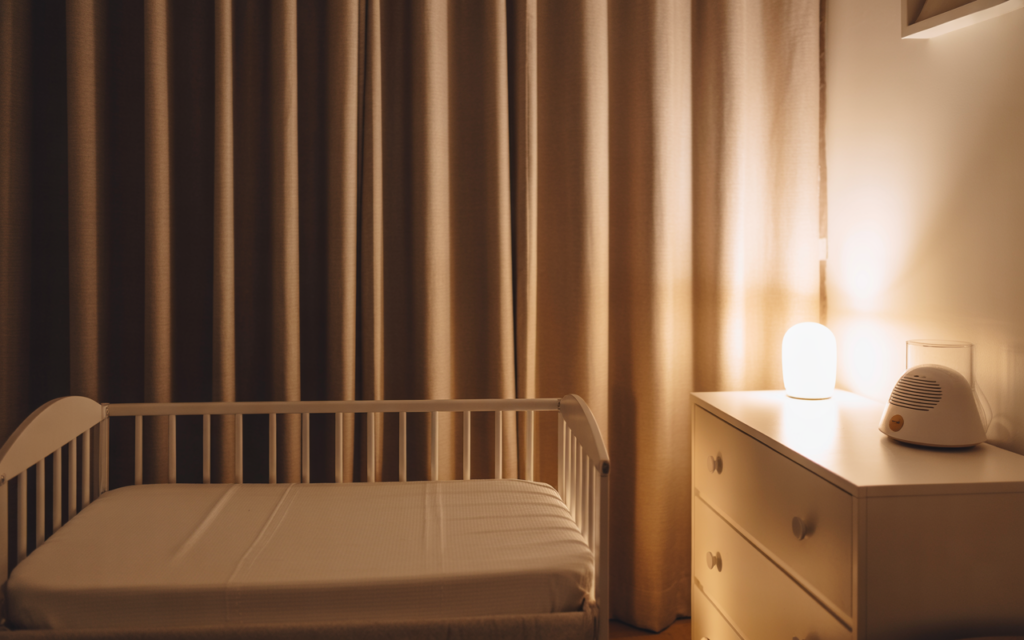
- Darkness: As close to pitch black as possible for naps and night. Invest in proper blackout blinds — not curtain liners, actual blackout. Light signals the brain to be alert.
- White noise: A consistent shushing sound at around 65-70 decibels (about the volume of a shower) masks household sounds and mimics the womb environment. Keep it on throughout the sleep.
- Temperature: 68-72F (20-22C) is ideal. Dress baby in one more layer than you’d be comfortable in. Feel the back of their neck — it should be warm but not sweaty.
- Safe sleep surface: Firm, flat, fitted sheet only. Nothing else in the crib until after 12 months.
Building a Simple Bedtime Routine
A consistent bedtime routine is one of the most evidence-backed strategies in baby sleep. It works by creating a predictable sequence of events that signals to your baby’s brain: sleep is coming.
It doesn’t need to be elaborate. A 15-20 minute routine is plenty. What matters is consistency — the same sequence, same order, every night.
A simple routine that works:
- Warm bath (or warm washcloth wipe-down if not bath night)
- Gentle massage with baby lotion
- Fresh sleep clothes and sleep sack
- Feed (breast or bottle) — ideally not the last step, to avoid feed-to-sleep association
- Song, story, or quiet cuddle
- Into the crib drowsy but awake
The “drowsy but awake” placement is the foundation of independent sleep. It gives your baby the chance to practice falling asleep in their sleep space rather than in your arms.
Frequently Asked Questions
When will my baby sleep through the night?
Most babies develop the physical ability to sleep longer stretches (6+ hours) somewhere between 4 and 6 months. Whether they do depends on many factors — feeding needs, temperament, sleep associations, and individual development. Sleeping through the night for a baby typically means a 5-6 hour stretch, not necessarily 12 hours.
Is it okay to let my baby cry?
Some crying during sleep learning is normal and does not harm your baby. The key distinction is between protest crying (fussing as baby adjusts to a new situation) and distress crying (genuine upset that needs a response). Research consistently shows that graduated approaches to sleep training do not cause harm to babies’ attachment or emotional development when used after 4-6 months.
My baby was sleeping great and suddenly isn’t. What happened?
Sleep regressions are real. They occur during developmental leaps — typically at 4 months, 8-10 months, 12 months, and 18 months. During these periods your baby’s brain is working hard on new skills, and sleep takes a hit. They always pass. The best approach is to maintain your routines, respond with warmth, and wait it out.
Should I wake my baby to feed at night?
In the newborn stage (first 4-6 weeks), yes — especially if your baby has not yet regained their birth weight. Most pediatricians recommend waking a newborn who has slept longer than 3-4 hours to feed. After your baby has established healthy weight gain, you can generally let them wake on their own to feed.
Is co-sleeping safe?
Bed sharing as typically practiced carries significant SIDS risk and is not recommended by major pediatric organizations. Room sharing — baby in a separate safe sleep space in your room — is both safe and recommended for the first 6-12 months. If you want to keep your baby close, a bedside bassinet that attaches to your bed is a safe middle ground many families find works well.
A Final Note for Exhausted Moms
Baby sleep is hard. Not because you’re doing it wrong — but because it genuinely is one of the more difficult parts of early parenthood, and anyone who tells you otherwise has either forgotten or got lucky.
The fact that you’re reading this at whatever hour it is, trying to understand your baby better — that already makes you a good mom.
Sleep will come. Not all at once, not on a schedule you’d choose, but it will come. Until then, this guide will be here every time you need it.